

forget big tech?
Your best entry-level job in 2026 might not have a logo you recognize.

The career advice everyone ignored
In November, Mark Cuban told graduating seniors what most career counselors won’t: skip Big Tech and go work for a 30-person company that needs help with AI.
It sounded contrarian at the time. Months later, the data is starting to agree with him.
Most career counselors are still running the 2019 playbook, and the market they trained on has quietly disappeared.

New grads now make up just 7% of all Big Tech hires, roughly half the share they held before the pandemic.
So the front door is barely open. The real question is which door to walk through instead.
What cuban actually said
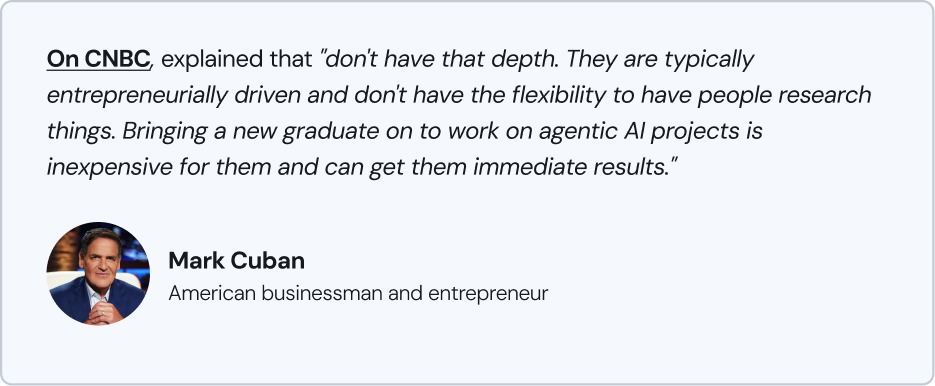
He doubled down a month later, telling graduating seniors directly that Big Tech is not where AI-fluent grads should be heading.
Big firms already have AI teams and consultants.
Small ones do not.
A grad who knows how to wire up agents adds visible value at a 30-person company starting day one.
I have been telling grads in our community the same thing for months. The data this year finally caught up.
The numbers behind the advice
Gusto, the payroll platform, runs a yearly forecast on small-business hiring, and its 2026 figure is hard to ignore.
Companies with fewer than 50 employees are expected to hire about 974,000 new grads between April and September.
That is the third straight year hiring has held near a million, even as Big Tech pulled back.
The roles themselves are changing too.

These are jobs that barely existed when this year's career-fair flyers went to print, at companies most grads have never heard of.
The offer at month six
Now, the money - since that is the first thing everyone asks about.
The average small-business offer for the class of 2026 is $65,734, according to Gusto.
That is up meaningfully from 2019 in nominal terms, though once you adjust for inflation, it sits a little below what grads earned a few years ago.
A Big Tech entry-level package, by comparison, lands somewhere around $190,000 once you count stock and bonus, per Levels. fyi data on L3 / E3 / SWE I total comp at Google, Meta, and Amazon.
That gap deserves an honest mention. But it leaves something out.
The grad applying to Big Tech is not being handed $190,000.
They are sending applications into a system that hired a quarter fewer grads last year than the year before.
For most people the honest comparison is not $65,000 against $190,000.
It is $65,000 against no offer at all.
The smaller company also comes with three things the Big Tech offer does not, and none of them show up on a comp sheet.
The first is proximity to the actual business. At a 30-person company you ship features, talk to customers, and watch revenue move because of something you built.
That kind of pattern recognition is what turns you into a real operator a few years in, long before your Big Tech peers have touched anything that mattered.
The second is speed. The first promotion at a big firm is often 18 to 24 months of review cycles.
At a company that goes from 50 people to 80 in a year, your title tends to catch up in six to nine months, because someone has to formally run the team you are already running informally.
The third is the founder. When the person who built and sold a company is sitting ten feet away, you pick up things no onboarding deck can teach.
That beats a Slack channel full of other people figuring it out

Where these jobs actually live
Most grads spend the months after graduation refreshing the LinkedIn job feed and applying to whatever has a logo they recognize.
Small businesses are not on the front page of that feed.
They do not pay for LinkedIn Recruiter seats or run university recruiting programs.
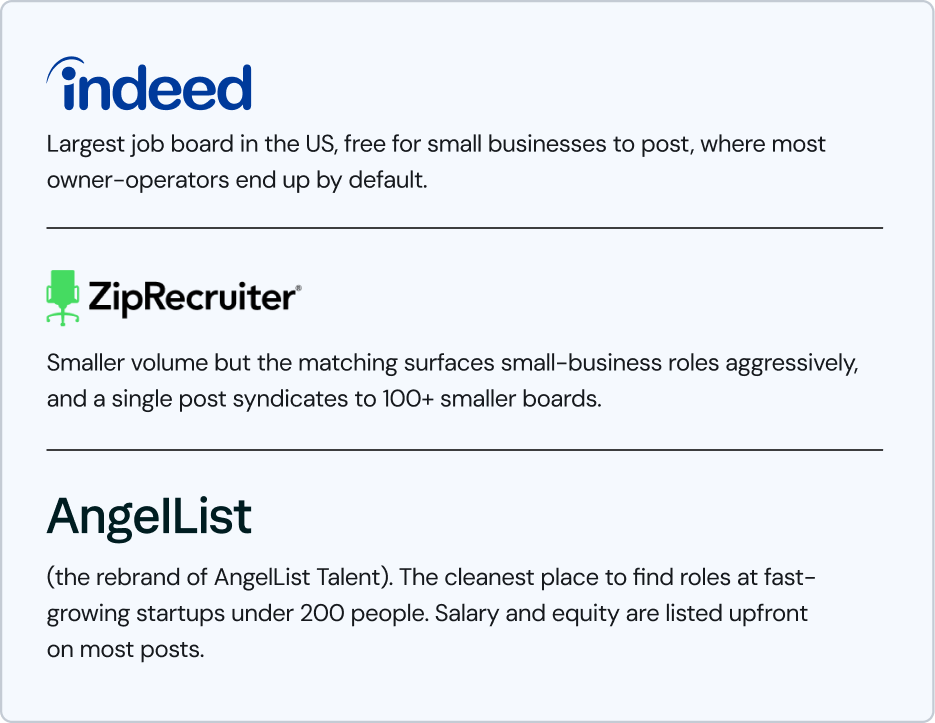
The company’s own careers page. This is the one most grads skip.
CareerPlug analyzed 60,000+ small businesses and found applicants who came through a careers page directly were 13% of applicants but 26% of hires.
Four times more likely to be hired than someone applying through a job board.
And referrals do even better. CareerPlug’s data shows that a referred applicant is roughly 11 times more likely to be hired than someone applying through a job board.
The resume that works for a founder
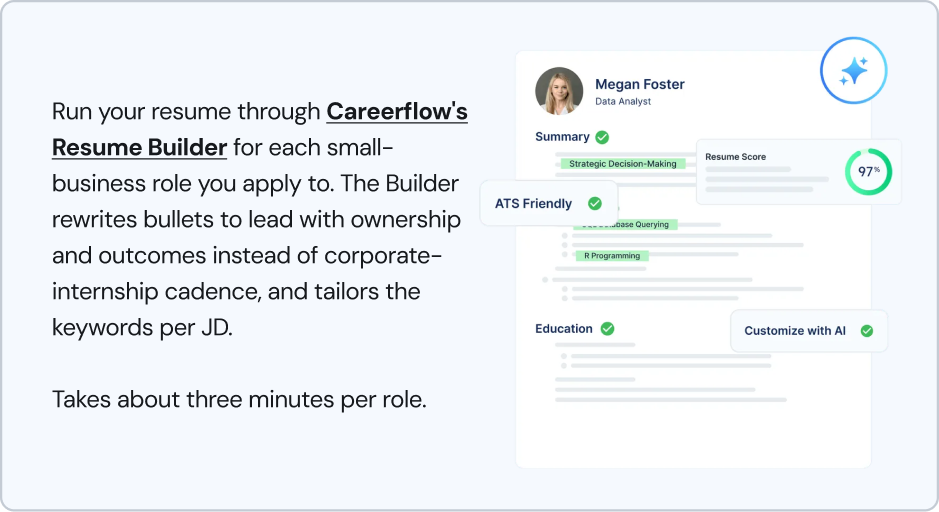
The resume that gets you past a Big Tech ATS does not work for a founder reading her own applications.
At Big Tech, the resume game is depth. One scope, one stack, deep ownership of a narrow problem, brand names the system recognizes.
The recruiter is scanning 200 profiles for keywords that match the JD.
At a 30-person company, the founder is reading 30 resumes herself with a coffee. What she wants is the opposite.
Breadth over depth. The grad who interned at a YC startup and built two side projects on weekends beats the grad with one summer at Microsoft. Founders pattern-match for people who finish things. They are not impressed by the brand name. They are impressed by what you did inside it.
Ownership over brand names. “Cut churn 18% at a 12-person SaaS by rebuilding the trial-to-paid email sequence” lands harder than “Project Manager Intern, [Brand Name Co.].” The founder wants to know what you have built, not where you sat for three months.
Quantified outcomes. Founders read numbers fast. “Grew our newsletter from 400 to 9,000 subscribers in six months” is worth more than “Managed social media accounts.”
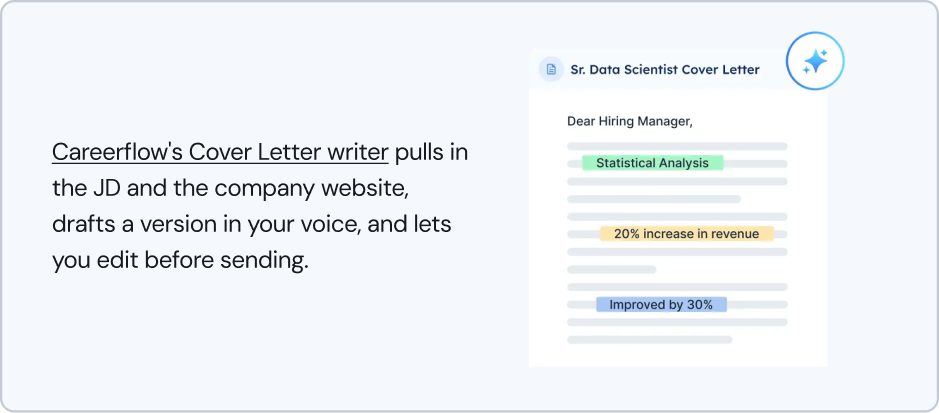
And then there is the cover letter. At Big Tech the ATS strips it before a human sees it, so most grads skip it. At a 30-person company, the founder reads it.
Sarah Keach Baucom of Girl Tribe Co. put it bluntly: “If there is no cover letter, I have no idea why someone would want to work with us.”
Three short paragraphs are enough. One specific thing you noticed about the company that most candidates would miss. One thing you have shipped that maps to the role, with the outcome up front. One specific reason you want to work there that is not “great culture.”
The search is messier than the Big Tech one
You will apply to 40 small companies that all post in different systems, the pipelines are slower, and the founders ghost more.
Careerflow's Job Tracker is a Kanban for the whole search. Roles, stages, follow-up dates, contact info per role, and the JDs themselves.
When the founder of company number 14 finally replies three weeks after you applied, you do not have to scroll back through your sent folder trying to remember what they do.
One last thing
There is a line from Naval Ravikant that fits this whole moment: “Apply specific knowledge with leverage, and eventually you will get what you deserve.”
A grad who joins the 30-person company with the AI problem, ships the thing, and watches the founder’s revenue move is doing exactly that.
It is not the flashier path, and it is genuinely harder to find than a posting with a logo you recognize.
But it builds the kind of experience that keeps paying off long after the first paycheck.
Your career is going to compound either way. This is really a choice about what you want it to compound on.
Multiple open roles at Careerflow AI - some of them listed below - if you are a fit, apply below.
And, if you know someone who is, send them this newsletter.
Data Collection Specialist (Household Task Video Contributor) (Remote | USA)
Chinese Data Annotator (Remote | International)
Japanese Data Annotator (Remote | International)
Danish Data Annotator (Remote | International)
German Language Data Annotator (Remote | International)
20+ more open roles on our job board.
See you next week.
Puneet