

pivot into AI Engineer?
It's the fastest-growing job on LinkedIn for the second year running. Here's the actual path in.

You didn’t miss the AI boom
Every few weeks at Careerflow, I sit in on a session with an engineer who wants to move into AI engineering.
They always show up with the same background and the same worry.
The background is backend, or data, or full-stack.
The worry is that they’ve missed the hiring window because they don’t have a PhD.
In reality, they haven’t missed anything.
The role is far more learnable than the job descriptions make it sound, and the LinkedIn data on who’s getting hired says the same thing.
So let me walk you through how this market really works, and what the pivot would take for you.
Who these jobs are going to
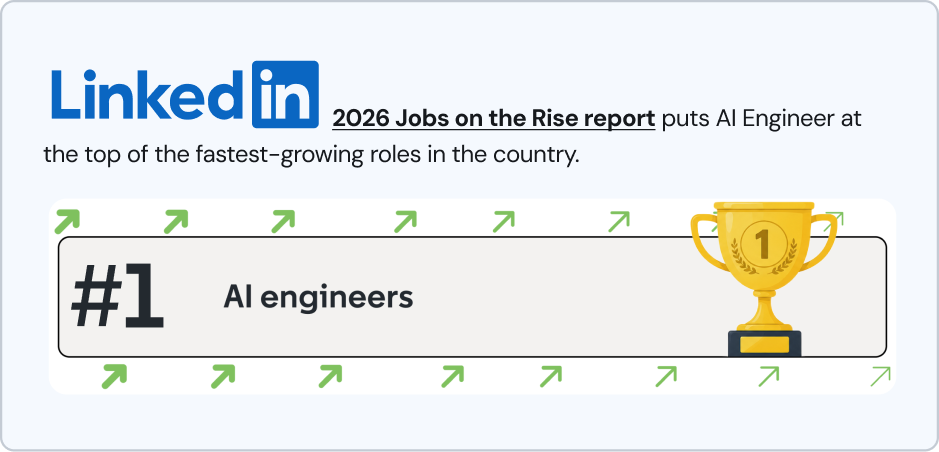
For younger workers, it’s held that spot for two years.
Between 2023 and 2025, LinkedIn added 639,000 AI-related job postings in the US, 75,000 of them for AI Engineer roles specifically.
What’s underneath is who’s filling them.
The median person taking one of these jobs has 3.7 years of experience, and the roles they’re coming from are Software Engineer, Data Scientist, and Full Stack Engineer.
The skills LinkedIn flags as most common aren’t research credentials either.
They’re LangChain, RAG, and PyTorch, which are tools you can pick up on your own time.
These jobs aren’t going to PhDs.
They’re going to engineers who already know how to ship production code and have picked up the LLM stack.
As Enhancv co-founder Volen Vulkov told Dice, an AI engineer now means "anything from heavy API consumption to even business solution consulting around bots."
If you’re three or four years into engineering work, you’re already sitting at the median experience level for these roles.
The distance between you and the people getting hired is mostly positioning.
Forget the research version
A lot of the intimidation comes from one title doing two completely different jobs at once.
One version is the research job. You’d train models from scratch, design new architectures, and publish papers.
That work happens at the frontier labs, places like Anthropic, OpenAI, and Google DeepMind, and the people doing it usually have PhDs and cleared a punishing hiring bar to get there.
That’s the version most people picture, and it’s the reason they count themselves out before they start.
The other version is the applied job, and it’s where almost all the hiring actually sits.
You’d build LLM-powered features.
You’d wire up retrieval over a company’s internal data so their assistant actually knows things.
You ship agents that handle real workflows, fine-tune existing models for specific use cases, and write a lot of Python, API glue, and evaluation harnesses along the way.
Of the 75,000 AI Engineer roles LinkedIn tracked, the overwhelming majority are of this second kind.
Once you see that distinction, the pivot stops being a question of going back to school and becomes a sequence any working engineer can run through.
Before you run it, though, fix the thing a recruiter sees first. If your headline still reads “Senior Software Engineer at TechCorp,” you won’t surface when she searches for AI Engineer, RAG, and LangChain.
That search is happening right now, and as it stands, it skips you.
Careerflow's LinkedIn Optimizer rewrites your headline, about section, and recent roles so you show up for the exact stack recruiters are searching. It takes about three minutes.
What the upcoming weeks look like
Most pivot advice falls apart right here, because it hands you a reading list of fourteen courses and eight textbooks. Nobody finishes that, and you won’t either.
The engineers I’ve watched make this jump did something much narrower, and they did it fast: six to eight weeks of focused evening and weekend work was enough.
Weeks 1-2: learn the applied stack
The first two weeks are for the applied stack, not deep learning from first principles.
Pick one of LangChain or LlamaIndex, not both.
Learn RAG, which is really just the set of techniques for connecting an LLM to a body of data it wasn’t trained on.
Get comfortable with prompting from the actual documentation rather than the Twitter version of it.
Anthropic’s and OpenAI’s prompting guides are the place to start.
Then pick one evaluation framework, something like LangSmith or Inspect, so you can measure whether what you built works instead of guessing.
Weeks 3-5: build one real thing, end to end
You have three weeks to build one real thing, end to end. Pick a use case you care about, because you’ll do sharper work on something that holds your interest.
That could be a RAG system over your favorite podcast’s transcripts, an agent that does one job well like drafting follow-up emails, or a fine-tuned model for a narrow domain task.
Whichever you pick, finish it, put it on GitHub, and write a README that explains the decisions you made and why you made them.
Week 6: write about what you built
A blog post, a LinkedIn breakdown, it doesn’t matter which. The hiring manager who reads your application later won’t be impressed that you used RAG, because everyone uses RAG.
What lands is that you understood the tradeoff between chunk size and retrieval quality, made a call, and can explain it. The writing is the proof that you did the work and understood it.
Weeks 7-8: apply, with everything rewritten
By week seven you’re applying, with everything rewritten to match. “Backend Engineer at X” becomes “Backend Engineer at X, building a RAG system over 50,000 documents in production with LangChain and Pinecone.” The rewritten headline and the GitHub link do most of the selling for you.
Rewriting every bullet to lead with your AI-adjacent work is tedious, which is exactly why most people half-do it.
Careerflow's Resume Builder takes the job description for an AI Engineer role and rewrites your bullets to lead with the relevant work you've already done, about three minutes per role.
The last hurdle is the interview, which at most of these companies now includes a system-design round built specifically around LLMs.
If you’ve never sat through one, the first will be rough, and there’s no reason to make your first one a real interview.
Careerflow's AI Mock Interview runs you through realistic LLM system-design and applied-ML scenarios, scores your answers, and shows you where you stalled. About thirty minutes a session.
What it pays
After all of that, the numbers justify the effort.
The median base salary for a US AI Engineer sits between $150,000 and $165,000, according to Codecademy’s read of Glassdoor, Built In, ZipRecruiter, and Levels.fyi.
Engineers with three to five years of experience land higher, roughly $170,000 to $240,000 in base, and once you fold in equity and bonus, total compensation in the $230,000 to $380,000 range is common.
For all those salary figures, the number that captures this market best is an hourly consulting rate.
PromptQL, an enterprise AI platform built by the San Francisco company Hasura, bills $900 an hour for its engineers to help Fortune 500 companies deploy AI on their own data.
CEO Tanmai Gopal told Fortune the rate lines up with what AI engineers generally command, and that "it feels like we should be increasing that price even more," because clients aren't pushing back.
For comparison, Big Four AI consulting partners tend to bill somewhere in the $400 to $600 range.
At $900, PromptQL is setting the new top of the market, and that money is going to the engineers who actually build the systems.
One last thing
I'll leave you with something Andrej Karpathy wrote in 2020. Karpathy is an OpenAI co-founder and Tesla's former AI director, and since May he's been on Anthropic's pretraining team, so he reads this market about as well as anyone alive. He posted this six years ago, and it has held up almost unreasonably well:
How to become expert at thing:
1) iteratively take on concrete projects and accomplish them depth wise, learning “on demand” (ie don’t learn bottom up breadth wise)
2) teach/summarize everything you learn in your own words
3) only compare yourself to younger you, never to others
The first point is the load-bearing one: pick a concrete project, finish it, and learn what you need as you go, not the other way around.
One applied project, written up clearly on a profile that reads like the job you’re after, is enough to get you in the room.
This market is hungry enough that if you ship one good thing, someone on a hiring team will find it.
A few roles are open at Careerflow right now. Some are remote, one of them pays you to do your chores, and all of them are real.
If you're a fit, apply below. If you know someone who is, forward them this.
20+ more open roles on our job board.
See you next week.
Puneet